Evaluating Funny Frog: A Practical Guide to Quirky Display Typography
In the vast landscape of digital typography, finding a display font that balances personality with legibility is often a challenge for designers. Funny Frog has emerged as a notable option in this space, offering a distinct aesthetic characterized by cute characters and a playful demeanor. For professionals and hobbyists aged 20 to 50 who are curating assets for branding, posters, or wall art, understanding the specific utility of such a typeface is crucial. This analysis explores what makes this font unique, where it fits within broader design strategies, and how it compares to other stylistic approaches to help you make an informed decision.
Defining the Aesthetic and Core Characteristics
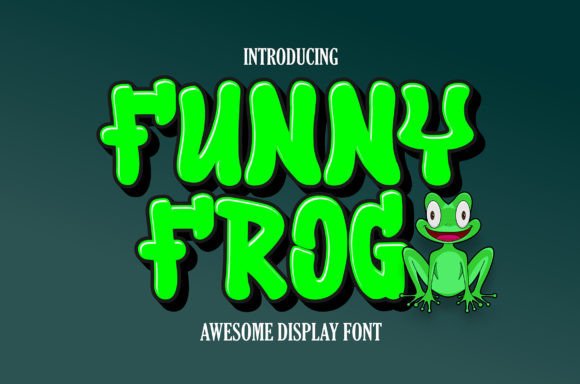
At its core, Funny Frog is a fun and quirky display font designed to inject immediate character into visual projects. Unlike neutral sans-serif or traditional serif typefaces intended for long-form reading, this font prioritizes expression. The letterforms often mimic organic shapes, potentially incorporating elements that suggest movement or whimsy, aligning with the "cute" descriptor found in its marketing. This makes it particularly effective for headlines, logos, and short bursts of text where the goal is to evoke emotion rather than convey dense information.
The distinctiveness of Funny Frog lies in its ability to soften a design. In a market saturated with geometric minimalism, a font with irregular strokes and playful terminals can serve as a powerful differentiator. It transforms standard headings into engaging visual hooks. However, the very features that make it charming—its quirkiness and decorative nature—also define its limitations. It is not a workhorse font for body copy; rather, it is a specialized tool meant for elevation and emphasis.
Strategic Fit: When to Choose This Style
Selecting the right typography is less about finding the "best" font and more about identifying the best fit for a specific context. Funny Frog excels in scenarios where the target audience expects approachability and joy. Consider the following use cases where this font typically outperforms more严肃 (serious) alternatives:
- Branding for Youth-Oriented Products: Companies selling toys, candies, or children's educational tools benefit from the inherent friendliness of the typeface.
- Event Marketing: Posters for community festivals, birthday parties, or casual gatherings require a tone that feels inviting rather than corporate.
- Wall Art and Decor: In interior design, text-based art often relies on the shape of the letters to carry the visual weight. The cute characters in this font make it suitable for nurseries, playrooms, or eclectic living spaces.
- Stickers and Merchandise: Small-scale applications like stickers demand high impact at small sizes. The bold, distinctive shapes of display fonts ensure readability even when scaled down.
Conversely, there are situations where Funny Frog may not be the optimal choice. If you are designing for a financial institution, a legal firm, or a luxury brand that relies on exclusivity and seriousness, the playful nature of this font could undermine the desired message. In these contexts, the "cute" factor might be perceived as unprofessional or lacking in authority.
Comparative Analysis: Display Fonts vs. Versatile Families
When evaluating Funny Frog, it is helpful to compare it against other categories of typography to understand its tradeoffs. Many designers initially gravitate towards versatile font families that offer dozens of weights and styles, from thin to black, and include italic variants. While these families provide consistency across a whole brand identity, they often lack the unique "spark" that a dedicated display font provides.
Funny Frog operates differently. It is likely a standalone display face or part of a limited set focused on style rather than utility. The tradeoff here is versatility versus impact. A standard geometric sans-serif might work for both a headline and a paragraph, but it rarely stops a scrolling user in their tracks. Funny Frog, by contrast, is designed specifically to stop the scroll. It sacrifices the ability to write a three-page report for the ability to create a memorable logo or a striking poster header.
Furthermore, compared to hand-lettered custom solutions, using a pre-made font like Funny Frog offers significant advantages in terms of cost and scalability. Custom lettering is unique but expensive and time-consuming to edit. A font file allows for instant iteration, easy kerning adjustments, and consistent reproduction across different media, from web browsers to large-format printing.
Technical Considerations and Legibility
One critical factor in adopting any display font is legibility. Quirky fonts often push the boundaries of standard letterforms, which can sometimes confuse readers if not used carefully. With Funny Frog, designers must be mindful of line height and spacing. Because the characters may have unusual ascenders or descenders to maintain their "cute" profile, tight leading can cause visual clutter.
It is also essential to consider the medium. On high-resolution screens and printed materials, the details of the font will shine. However, on low-resolution displays or when viewed from a distance, some of the finer quirky details might get lost, reducing the text to illegible blobs. Therefore, testing the font at various sizes is a mandatory step in the evaluation process. If the project requires small print, such as footnotes or dense packaging information, pairing Funny Frog with a clean, neutral sans-serif for the supporting text is a recommended best practice.
Making the Final Decision
Ultimately, the decision to use Funny Frog should depend on the emotional resonance required by your project. Ask yourself: Does this design need to feel serious and authoritative, or does it need to feel human, accessible, and fun? If the latter, this font offers a ready-made solution that avoids the generic look of default system fonts.
For those exploring alternatives, consider whether you need a single standout font for headers or a complete system. If your project involves extensive UI design or long-form content, Funny Frog should be treated as an accent rather than the primary voice. Use it to highlight key messages, brand names, or calls to action, while relying on more subdued typefaces for the heavy lifting of information delivery.
In conclusion, Funny Frog represents a specific tool in the designer's toolkit—one that excels at bringing warmth and personality to visual communications. By understanding its strengths in branding, posters, and decorative arts, and acknowledging its limitations regarding formal contexts and body text, you can deploy it effectively. The goal is not just to choose a font that looks interesting, but one that solves the communication problem at hand. When the objective is to elevate a design with charm and approachability, this quirky display font stands out as a compelling option worth serious consideration.