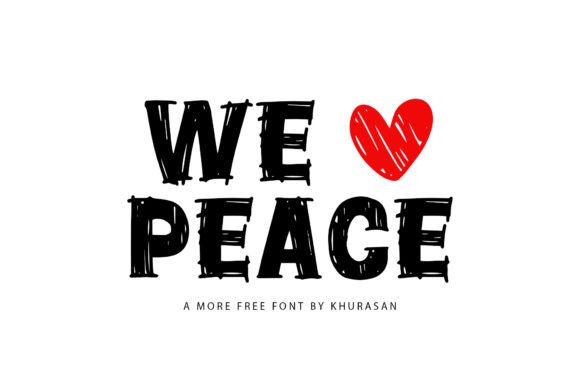
Evaluating We Love Peace: A Practical Guide to Its Design Fit and Alternatives
In the crowded landscape of modern typography, finding a display font that balances personality with legibility is often a challenge for designers. We Love Peace has emerged as a notable option in this space, offering a distinct aesthetic that blends rounded, friendly contours with a contemporary edge. For professionals aged 20 to 50 who are curating visual identities for brands, publications, or digital campaigns, understanding where this typeface fits within a broader design strategy is essential. It is not merely about selecting a "cute" font; it is about evaluating whether its specific character traits align with the tone and functional requirements of a project.
This analysis explores the characteristics of We Love Peace, compares its utility against other stylistic categories, and outlines the scenarios where it serves as an optimal choice versus when an alternative approach might be more effective.
Defining the Aesthetic and Functional Profile
At its core, We Love Peace is classified as a modern display font. Its primary visual hook lies in its soft, approachable geometry. Unlike rigid geometric sans-serifs that can feel cold or corporate, this typeface utilizes generous curves and open counters to create a sense of warmth. The "cute" descriptor often applied to it refers to these softened terminals and a slightly irregular baseline that mimics hand-lettered imperfections without sacrificing the consistency required for professional typesetting.
The distinctiveness of We Love Peace comes from its ability to convey positivity and inclusivity through form. In a market saturated with ultra-minimalist fonts, it offers a return to humanism. However, from a practical standpoint, its weight distribution and x-height are calibrated specifically for larger sizes. While some display fonts struggle when scaled down, We Love Peace maintains reasonable clarity in sub-headings, though it is rarely suitable for body copy. This limitation is a crucial factor in resource evaluation; it is a tool for emphasis, not for exposition.
Comparative Analysis: Display Styles and Categories
To make an informed decision, one must compare We Love Peace against other common typographic approaches. When evaluating options, designers typically weigh three main categories: strict geometric sans-serifs, organic script fonts, and rounded display faces.
- Vs. Strict Geometric Sans-Serifs: Fonts like Futura or Avant Garde offer precision and authority. If a project requires a tone of serious innovation or high-end luxury, We Love Peace may appear too informal. The trade-off here is between professionalism and approachability. Where geometric fonts command respect, We Love Peace invites connection.
- Vs. Organic Script Fonts: Handwritten scripts provide maximum personality but often suffer from legibility issues, especially in all-caps settings or on digital screens. We Love Peace offers a middle ground. It retains the friendly, human touch of a script but maintains the structural integrity of a sans-serif, making it far more versatile for logos and banners where instant recognition is vital.
- Vs. Other Rounded Displays: Many rounded fonts lean heavily into a "bubble" aesthetic that can feel juvenile. We Love Peace distinguishes itself by moderating this roundness with modern straight lines in certain strokes, preventing it from looking like a children's book font unless specifically styled that way. This nuance allows it to cross over into lifestyle branding and magazine headers aimed at adults.
Optimal Use Cases and Project Fit
Identifying the right environment for We Love Peace is key to maximizing its impact. Based on its structural properties, several specific applications stand out as ideal fits:
- Poster Design and Event Branding: The font's bold presence makes it excellent for posters promoting community events, wellness workshops, or cultural festivals. Its inherent positive vibe reinforces messages related to harmony, nature, and social connection.
- Lifestyle Logos: For startups in the eco-friendly, parenting, or artisanal food sectors, We Love Peace can serve as a primary logotype. It signals that the brand is accessible and customer-focused rather than distant or industrial.
- Magazine and Book Covers: In editorial design, this typeface works well for titles dealing with self-help, modern living, or light-hearted fiction. It grabs attention on a shelf without appearing aggressive.
- Digital Banners: Its clear letterforms translate well to web headers and social media graphics, provided the background contrast is sufficient.
However, the versatility of We Love Peace does have boundaries. It is less effective in contexts requiring neutrality, such as financial reporting, legal documentation, or high-tech hardware interfaces. In these scenarios, the font's personality might distract from the data or undermine the perceived stability of the institution.
Limitations and Decision Factors
Every design resource carries trade-offs, and acknowledging the limitations of We Love Peace is part of a professional evaluation process. One significant consideration is pairing. Because the font is so distinctive, it demands a subdued partner for body text. Pairing it with another decorative font would create visual chaos. Instead, it works best when contrasted with a neutral, highly legible sans-serif or a classic serif for long-form content.
Another factor is cultural context. While the name and style suggest universal positivity, designers must ensure the "cute" aesthetic aligns with the target demographic's expectations. For audiences seeking cutting-edge avant-garde design or stark brutalism, We Love Peace may feel too soft or conventional. It is a font that leans towards the mainstream of contemporary "friendly" design, which is a strength for mass appeal but a potential weakness for niche, edgy markets.
Furthermore, licensing and format availability should be verified before integration. While many modern fonts offer extensive language support, display fonts sometimes have limited glyph sets. Ensuring that We Love Peace supports the necessary special characters or international glyphs for a global campaign is a necessary step in the vetting process.
Making the Final Choice
Ultimately, choosing We Love Peace is a decision about tone. If the goal is to create a design that feels welcoming, optimistic, and distinctly modern, this typeface is a strong contender. It excels in projects where the emotional connection with the viewer is prioritized over rigid formalism.
However, if the project demands absolute neutrality, extreme technical precision, or a dark, moody atmosphere, exploring alternatives in the geometric or slab-serif categories would be more prudent. The value of We Love Peace lies not in being a universal solution, but in being a specialized tool for crafting lovely, standout designs in the right context. By weighing its friendly aesthetics against the specific functional needs of your project, you can determine whether it is the missing piece in your creative toolkit or if a different direction better serves your objectives.